For professionals in financial services, insurance, real estate, law, consulting, healthcare, and beyond—where trust and relationships make all the difference.
Selling is Easy.*
PROSPECTING? That's Difficult!
Isn't it Time You Replaced Random Acts with Rhythmic Growth?
Listen to a 2-minute introduction from Keith Luscher, creator of Prospect & Flourish:

Prospect & Flourish isn’t a one-size-fits-all system.
It’s a program that teaches timeless skills in human engagement, networking, referrals, messaging, and marketing—while guiding you to create your own structure for PROSPECTING and rhythm for EXECUTION.
The Result: A framework you design that lives, breathes, and grows with you.
>>>or scroll down to learn more

It’s Not that You Can’t Prospect - You Just Never Received a Process That Fits You.
The Real Issue...
You’ve been handed “systems” that weren’t built for you—created by someone else, in another time and place (like cold call lists or scripts that never fit you).
No wonder they don’t stick. Instead of helping, they leave you doubting yourself and wondering if you’re really cut out for this.

Where Does That Leave You?
Without a process that actually fits your strengths and your industry, you end up:
Falling back on random acts of prospecting—short bursts of activity, followed by silence
Not always sure who to contact or what to say when you do.
Struggling to stay consistent, while your confidence slowly erodes.
And that doubt is what really holds you back.

You Deserve Better.
It shouldn’t be this hard for people who lead with integrity. You shouldn’t have to force yourself into someone else’s mold just to succeed.
Good, competent professionals like you deserve a process you can own—one that fits how you work, and who you are.

You’re Not Alone.
We know what it’s like to second-guess your own outreach—to hesitate, overthink, and get stuck in cycles of doubt. Every professional who succeeds has faced the same frustration.
That’s why Prospect & Flourish™ exists.
This isn’t theory or a quick-fix formula. It’s the result of nearly 30 years of real-world work helping professionals grow through trust-first conversations. Originally developed for the insurance industry more than 20 years ago, this program has been refined through books, workshops, and direct application across multiple industries.
It has helped countless professionals replace randomness with clarity and confidence—not by handing them another rigid system, but by guiding them to build a process of their own.
Now it’s your turn to create a process–and system–that finally fits you.
Who is this For?
Financial Advisors
Insurance Agents
Real Estate Agents
Fractional Executives
Business Consultants
Attorneys
B2B Sales Executives
Lending Officers
Recruiters
financial advisors
insurance agents
real estate agents
fractional execs
business consultants
attorneys
b2b sales execs
lending officers
recruiters
...and anywhere trust and relationships make all the difference.
Get Started Today:
STEP 1
Break Free from Random Acts
Stop bouncing between disconnected tactics and random bursts of activity that never add up.
You’ll reset your approach and leave behind the noise of one-size-fits-all systems.
STEP 2
Discover Timeless Principles
You’ll learn proven skills in human engagement, networking, referrals, messaging, and marketing.
These are principles that work across industries and situations, no matter your style.
STEP 3
Build YOUR OWN Process
Stop bouncing between disconnected tactics and random bursts of activity that never add up. You’ll reset your approach and leave behind the noise of one-size-fits-all systems.
It really is this straightforward. And it can start today.

Why This Works When Other Systems Don’t
Because you don’t need another formula—you need a process that actually fits you.
Most programs fail because they hand you a rigid formula and expect you to fit into it. That’s why so many systems never last. Prospect & Flourish is different. It’s built on timeless principles of trust, communication, and human engagement—but it doesn’t stop there.
You will learn how to shape those principles into a prospecting process that fits your strengths, your temperament, and your industry. The result isn’t another system to memorize. It’s a structure you design for yourself—practical, personal, and sustainable.
That’s why this program works—not just for a season, but for the long run.
A Proven Program. A Simple Investment. A Choice That Fits You.
When you join Prospect & Flourish™, you’re not just buying another course—you’re building a process you can own for life. Every module, every worksheet, every tool is designed to help you create a prospecting system that actually fits you, and keeps working long after other “formulas” fade.
To make it simple, we’ve set up two easy ways to get started—so you can choose the path that works best for your budget. And whichever option you choose, you’ll get full permanent access to everything inside the program, backed by our Lifetime Guarantee.
option 1: Pay in full
(best value)
$297
One-time payment of $297
Immediate access to all modules, lessons, and tools
Save compared to the installment plan

Lifetime Guarantee - No Questions Asked.
option 2:
(payment plan)
$102 today
Three monthly payments of $102
Same full access starting today
Small $5 per installment admin fee included
Lifetime Guarantee - No Questions Asked.
INSTANT DOWNLOAD
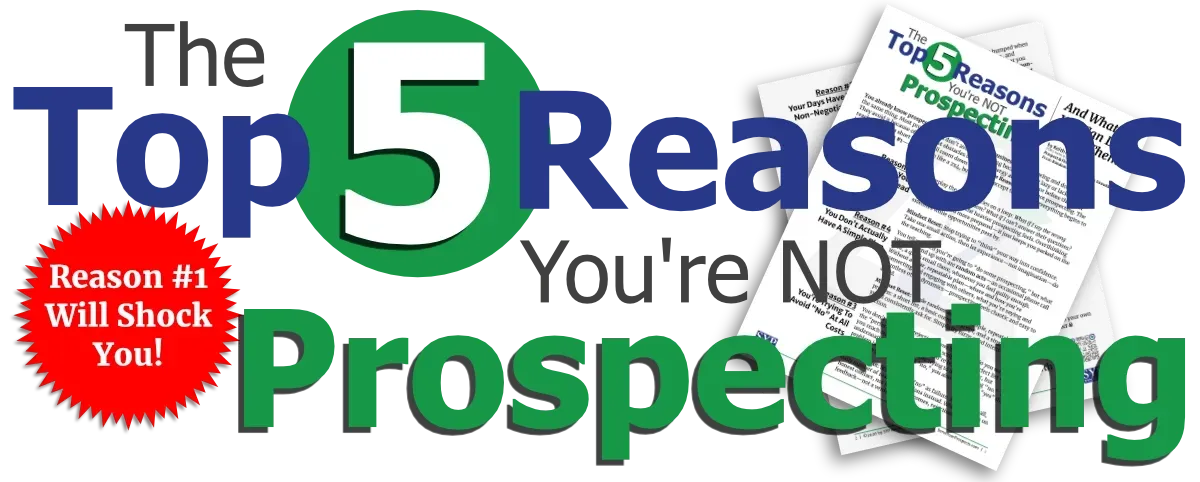
10-MINUTE READ: If you’re not ready to jump into the full Prospect & Flourish™ program yet, this is a simple first step. In about ten minutes, this guide shows you the five biggest reasons most professionals struggle to prospect consistently—and the Mindset Resets that help you start fixing the one that’s holding you back the most.
Identify which of the five reasons hits you hardest
Learn the simple mindset shift that goes with each one
Walk away with one concrete action you can take this week
Reason #1 Will Shock You!
You’ll get the PDF instantly by email, plus a short follow-up series to help you put it to work.
Get “The Top 5 Reasons You’re NOT Prospecting”
(And What You Can Do About Them)
Here's what others have said on AMAZON about previous editions of Prospect & Flourish...
High Praise for Prospect & Flourish

Must-buy for anyone in sales!
Keith Luscher has taught me strategies of how to gain a potential client's attention without portraying the image of a salesman, and how to keep an existing client loyal. In fact, we are using his book as a teaching tool in my networking group. Highly recommend to anyone in sales.
- Matt Bradford, CTO - InsightETE Corporation

Great Professional Development ROI
Keith has revealed a real formula for sales success. You just need to get the book and read it. And why not? ... This is a great investment in yourself as a business owner or sales professional.
- Frank Agin, Author, President/CEO, AmSpirit Business Connections

Great resource for busy sales professionals and sales leaders
Less than 20% of all sales professionals are calling on the right people within their markets. Prospect and Flourish helps you find the right people and then get an appointment with them...If you’re an entrepreneur, sales professional, or leading a sales team, this material helps you break through the noise and deliver quality sales results quickly.
- Tripp Braden, Succession Management Advisor

STILL NOT SURE?
See Exactly What's Inside
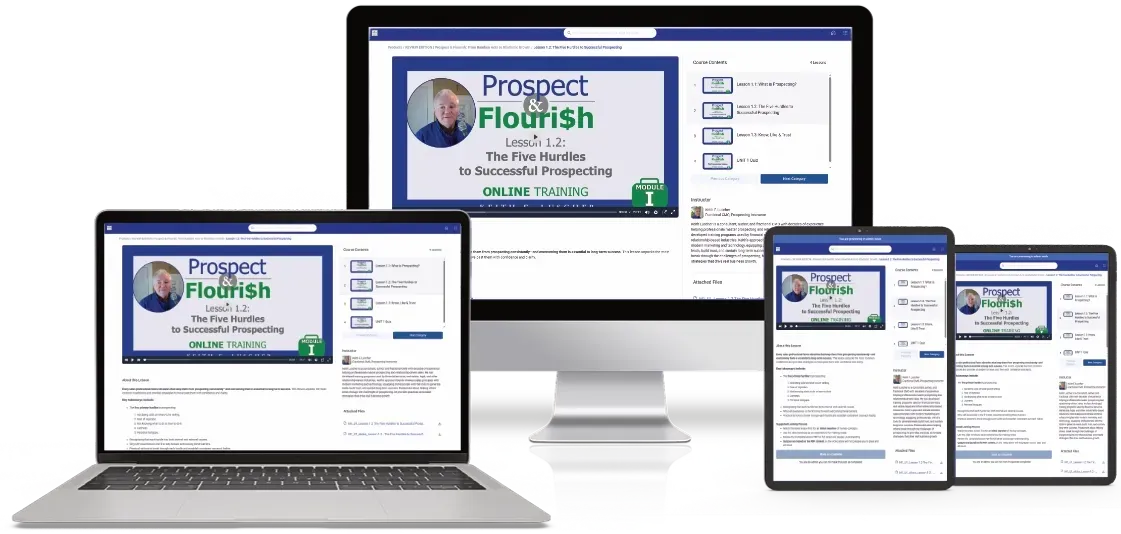
Four Modules, Ten Units, 36 Individual Lessons (with downloadable worksheets and tools)
If you’re the type who likes to know all the details before you decide, here’s the complete program breakdown.
NOTE: Each module builds on the one before it. To keep you moving step by step, lessons and units unlock only after you complete the quizzes that follow them. This ensures you master the essentials before advancing to the next stage.
Module I: Getting Started
Module I lays the foundation for Prospect & Flourish by tackling the core misunderstandings that cause most prospecting efforts to fail. Instead of diving straight into tactics, this module invites you to pause, reframe, and examine the “why” behind your outreach. The result is a mindset and message rooted in clarity, alignment, and strategy. This is where the shift begins—from random acts of prospecting to intentional, purpose-driven engagement.
Tap or Click on a Unit to see Summary and Lessons.
Unit 1: The Prospecting Enigma
Prospecting is often misunderstood, avoided, or approached with outdated habits. This unit reveals the deeper challenges behind ineffective outreach and sets the stage for a more principled and confident approach.
• Lesson 1.1: What is Prospecting?
• Lesson 1.2: The Five Hurdles to Successful Prospecting
• Lesson 1.3: Know, Like & Trust
• Unit 1 Quiz
Unit 2: Not Everyone is a Prospect
A powerful lesson in discernment. Learn to focus on the right people at the right time—by identifying fit, readiness, and alignment—rather than wasting energy on unqualified contacts.
• Lesson 2.1: If Everyone is a Prospect, Then No One Is
• Lesson 2.2: Do You Know Your Market?
• Lesson 2.2: Worksheet: Natural Market
• Lesson 2.3: What’s Your Niche?
• Lesson 2.4: Your Customer Persona...SIMPLIFIED!
• Unit 2 Quiz
Unit 3: Sharpen Your Point of Contact
Discover how to position yourself clearly and memorably. This unit refines the way professionals describe who they serve, what they offer, and why it matters—so your outreach actually lands.
• Lesson 3.1: Create Your Brand Message & Value Proposition
• Lesson 3.2: The Secret to Script Success
• Lesson 3.3: Life’s Most Important Skill
• Unit 3 Quiz
Module II: Build Momentum
Module II shifts you from foundational thinking to forward motion—helping you build momentum through real-world connection, meaningful relationships, and clear personal benchmarks. This module is about anchoring good strategy in consistent action. You’ll learn to engage your network with purpose, track progress that actually matters, and recognize the powerful moments where trust and opportunity intersect. The goal isn’t just to move—but to move in alignment with who you are and what you offer.
Tap or Click on a Unit to see Summary and Lessons.
Unit 4: Networking for Prosperous Relationships
Discover how to build a network that actually works. This unit reframes networking as an opportunity to invest in others, deepen trust, and create reciprocal value—not just exchange business cards.
• Lesson 4.1: What is Networking?
• Lesson 4.2: Centers of Influence (Networking, Newtonian Style)
• Lesson 4.3: Becoming Socially Mobile
• Lesson 4.4: Networking Organizations & Referral Groups
• Lesson 4.5: Your Personal Board of Advisors
• Unit 4 Quiz
Unit 5: Setting Your Benchmarks
Progress begins with clarity. This unit introduces tools to set and track personal success metrics—based not on vanity numbers or generic goals, but on meaningful behaviors that drive long-term growth.
• Lesson 5.1: Discipline & Perseverance
• Lesson 5.2: Structure Determines Behavior
• Lesson 5.3: The Problem with Problem-Solving
• Lesson 5.4: Begin Your Structural Blueprint
• Unit 5 Quiz
Unit 6: Your Moment of Truth
Every conversation is an opportunity to add value—or miss it. This unit equips you to show up fully in the moments that matter, aligning action, intention, and integrity when it counts most.
• Lesson 6.1: Service and Prospecting
• Lesson 6.2: Seek Out Moments of Truth
• Lesson 6.3: The Eight Rules of Outstanding Service
• Unit 6 Quiz
Module III: Advanced Strategies
Module III introduces you to the specialized strategies that set Prospect & Flourish apart from conventional sales and marketing approaches. At this stage, you’ll learn not only how to maintain momentum—but how to amplify it through targeted, trust-based processes. These advanced methods combine marketing with relationship-building, helping you reach further, qualify faster, and deepen engagement through both digital and in-person channels. This is where nuance and mastery begin to take shape—anchored in integrity, delivered with precision.
Tap or Click on a Unit to see Summary and Lessons.
Unit 7: Know Like & Trust Marketing
Move beyond generic lead generation. This unit introduces the Know–Like–Trust Funnel™—a trust-first marketing strategy that warms up prospects before the first real conversation ever begins.
• Lesson 7.1: Prospecting IS Marketing
• Lesson 7.2: The Know, Like & Trust Funnel
• Lesson 7.3: Marketing’s Silver Bullet
• Unit 7 Quiz
Unit 8: The Wedge
Designed for highly competitive environments where no prior connection exists, this unit teaches B2B professionals how to engage C-suite decision makers—without manipulation or pressure. A strategy for standing out by serving first.
• Lesson 8.1: Strategic Setup (Preparing Your System)
• Lesson 8.2: Tactical Execution (Deploying the Wedge)
• Lesson 8.3: Systematizing The Wedge
• Unit 8 Quiz
Unit 9: From Screen-2-Screen to Face-2-Face
Digital outreach is only the beginning. This unit helps you bridge the gap between online interaction and real-world trust, guiding digital connections toward meaningful face-to-face conversations.
• Lesson 9.1: Prospecting with Social Media
• Lesson 9.2: Where to Show Up—and How
• Lesson 9.3: The 12 Laws of Social Media Prospecting
• Unit 9 Quiz
Module IV: Muscle Memory
At first glance, Module IV may seem shorter—just one unit, one lesson, one final step. But beneath that simplicity lies something deeper: the shift from learning to living. After everything you’ve built in the first three modules, this final section isn’t about more content—it’s about integration. This is where structure becomes rhythm, and rhythm becomes identity. You’ll bring together focus, habit, intention, and purpose across all dimensions of life and work so that consistency becomes second nature.
Tap or Click on a Unit to see Summary and Lessons.
Unit 10: Prospect and Flourish Every Day
Mastery isn’t about knowing more—it’s about doing the right things with rhythm and intention. Picking up and continuing progress initiated in Unit 5, this final unit introduces a framework for consistent action, aligning your interior life, personal habits, and professional calendar. It’s the path to showing up daily—with clarity, purpose, and joy.
● Mindset Reset
● Lesson 10.1: Focus Beats Brilliance
● Lesson 10.2: Focus Time and Deep Work
● Lesson 10.3: Structuring Your Public Availability
● Lesson 10.4: Revisiting Your Integrated Life
● Lesson 10.5: Living Your Blueprint…Every Day
● Unit 10 Quiz
STILL NOT SURE?
Frequently Asked Questions
Don’t see your question? Let us know and we will do our best to answer it.
Q: Two months later, I’ve slipped back into my old reactive routines. What should I do?
That’s normal—and we address it directly in the program. It’s called oscillation: the back-and-forth between old patterns and new ones. It’s the same reason most diets fail.
The key is recognizing it quickly. Awareness is the first step to turning things around before it becomes a setback. Prospect & Flourish equips you with tools and structures to help you stay consistent—and you’ll also have access to a supportive learning community designed to keep you accountable and moving forward.
Q: Isn’t this just another sales training program?
Not at all. In fact, if you already have a good sales training program, Prospect & Flourish will complement it—not compete with it.
Most sales programs touch on prospecting or lead generation, but only in passing. Prospecting usually gets reduced to a few scripts, tips, or quick exercises, while the bulk of the training focuses on closing skills and presentations. That leaves a huge gap—the very front end of the sales process—where most professionals struggle.
That’s why Prospect & Flourish exists. This program is dedicated solely to prospecting. It doesn’t teach you someone else’s canned system. Instead, it guides you in building a structure of your own, tailored to your strengths and your industry. The result is a process that fuels your sales training—not a replacement for it.
*Q: What do you mean, “Selling is easy”? No, it’s not!
You’re right—selling isn’t easy. It takes hard work, professionalism, and a genuine commitment to creating value for your clients. That’s the only way you build lasting success.
But here’s the truth: for professionals who understand this and practice it with integrity, selling itself gets easier over time. The real struggle isn’t in serving clients—it’s in finding them. Prospecting is the weakest link in the sales chain, and the part most training skips over.
That’s why we say: "Selling is easy." It’s prospecting that’s difficult. And that’s exactly where Prospect & Flourish helps you the most.
Q: I want a program tailored to my industry. Do you offer that?
The core principles of prospecting are the same across every field—human engagement, trust, and consistent follow-through. What changes is how those principles get applied in your specific industry. That’s why Prospect & Flourish includes a wide range of examples and applications drawn from different professions.
If you’re looking for something even more specialized, we can help. Prospect & Flourish is also available as an internal, company-wide solution—customized for your industry and deployed cost-effectively across larger teams. To discuss further, contact Keith Luscher at [email protected].
Q: Can I get CE credit for completing the program?
In some cases, yes. Generally speaking, CE availability varies by industry and their respective governing bodies. For Registered Securities Representatives, Prospect & Flourish qualifies for CE credit under the Firm Element portion of Continuing Education, as monitored by FINRA. Each brokerage firm determines what counts toward its own requirements.
If you’d like CE credit in your field, let us know. We’ll be glad to explore options and work with you to make it possible.
Q: Why take it online?
Earlier editions of Prospect & Flourish were only available as textbooks. Over the years, countless professionals asked for an online version—and for good reason. The online program gives you flexibility:
● Learn at your own pace, on your own schedule.
● Revisit lessons anytime for reinforcement.
● Download worksheets and tools you can put to work immediately.
And if you prefer to study from printed materials, you can also add the hard-copy binder edition—loose-leaf bound with tab dividers. This format makes it easy to follow along, organize your notes, and even add updated curriculum as the program grows.
In short, you get the best of both worlds: the convenience of online learning plus the structure of a physical edition you can keep at your side.
Q: How much time will this take each week?
Each video lesson summary about 10–15 minutes, accompanied by the printed curriculum (upon which the quizzes are based) so you can learn in focused bursts. The printed curriculum goes deeper, and absorbing it will take a bit longer.
But like any self-study course, you set the pace. Some professionals move quickly through the material, while others spread it out and revisit lessons as they apply them in the field. The key is consistency—not speed—and you’ll have lifetime access so there’s no deadline hanging over your head.
Q: What if I’ve tried other systems before and they didn’t stick?
That’s exactly why Prospect & Flourish exists. Most programs hand you someone else’s system and expect you to force yourself into it. It might work for a while, but it rarely lasts—because it wasn’t designed for you.
This program is different. We don’t hand you a cookie-cutter formula; we guide you in building a process of your own. Yes, while it's built upon timeless principles that our foundational to all of us in life, what strategies you choose to deploy how you apply them are up to you.
That way, it fits your strengths, your industry, and your style of working. When you create it, it sticks—because it’s yours.
Q: Can my whole team use this program?
Absolutely. While Prospect & Flourish is designed for individual professionals, it can also be deployed across an entire team or company. In fact, organizations would benefit from its shared framework so everyone develops consistent prospecting habits and language.
We offer company-wide solutions that make it easy and cost-effective to roll out the program for groups of producers. If you’re interested in equipping your whole team, just reach out—we’ll be glad to discuss the options.
Q: Will this work if I’m new to sales?
YES!!! Prospect & Flourish is designed to meet you where you are. If you’re brand new, it gives you a strong foundation in prospecting—the part of sales most beginners struggle with. And if you’re more experienced, it helps you refine your habits and build a process that finally sticks. Either way, you’ll walk away with a framework that fits you, your style, and your industry.
Q: Do I need special tools or software to use this program?
No special software is required. All you need is an internet connection to access the online lessons. The worksheets and tools are provided as simple downloads—easy to print, save, and use in whatever way works best for you.
If you prefer print, you can also add the hard-copy binder edition, which organizes everything with tab dividers for quick reference and easy updates.
If you’re committed to learning and applying, Prospect & Flourish will fit you.
What’s the ROI?
Let’s be honest—you’re not here for theory. You’re here because you need results. The real question is: what is one new client worth to you? Two? Ten? The truth is, this program pays for itself quickly—often with your very next opportunity.
Financial ROI: One client relationship can more than cover the cost of the program. Every client after that is pure return.
Time ROI: No more wasted hours on unfocused, stop-start prospecting. You’ll spend less time spinning your wheels and more time in real conversations.
Emotional ROI: Confidence replaces doubt. Instead of dreading prospecting, you’ll have a process that keeps you moving forward.
That’s why the question isn’t whether you can afford this program—it’s whether you can afford to keep prospecting the old way.

While Nothing is Risk Free...
This comes with a 100% LIFETIME Guarantee.
Let’s be real: anytime you pay for something, there’s always a bit of risk. We get that. That’s why Prospect & Flourish comes with a simple promise: if you ever feel the program isn’t delivering value, let us know. We’ll refund your purchase—whether it’s 30 days or three years.
No hoops to jump through. No hidden conditions. Just a straightforward commitment to stand behind what we’ve built.
Your Prospects are Waiting!
By now you’ve seen the full program, the ROI it delivers, the questions answered, and the Lifetime Guarantee that backs it. You know exactly what’s inside—and what it can do for you.
Now the choice is simple: keep struggling with random acts of prospecting, or finally build a process that fits you and fuels your success.
option 1: Pay in full
(best value)
$297
One-time payment of $297
Immediate access to all modules, lessons, and tools
Save compared to the installment plan
Lifetime Guarantee - No Questions Asked.
option 2:
(payment plan)
$102 today
Three monthly payments of $102
Same full access starting today
Small $5 per installment admin fee included
Lifetime Guarantee - No Questions Asked.

Still Not Sure?
Few business activities force you to step outside of your comfort zone more than prospecting; Indeed it occurs with professionals of all ages and experience levels. Enrolling in this program alone of course will not bring you the results you want—you know you will need to absorb it at your own pace, but begin taking action immediately.
That said, I know that most in-depth online training programs can be pricey, which can be prohibitive for someone who may just be starting out. That’s why I wanted to offer it at a “no-brainer” price-point, backed by a LIFETIME GUARANTEE. That’s how much I believe in it, and believe in YOU.
That said, if you have any additional questions, reach out to me directly. You may ring me at (740) 273-6494, or drop me an note at [email protected].
However you decide, my hope is that you choose to prospect with purpose…and flourish every day.

Photo Credits:
Image by Olivier Girard from Pixabay
Photo by Andrea Piacquadio
Additional Photos by LinkedIn Sales Navigator via Pexels